This document describes the main risks that may affect the Group's business performance and financial position, etc., and that may have a significant impact on investor decisions.
Please note that any matters relating to the future are based on judgments made by our Group as of the last day of this consolidated fiscal year.
Our group comprehensively identifies and evaluates significant risks that could affect our operating results and financial condition each year, taking into account social conditions, the business environment, and the group's management challenges.
Furthermore, significant risks specific to each business are identified and evaluated annually by the relevant department, and then decided upon after review by the Risk Management Committee.
In selecting significant risks, we consider not only the likelihood of occurrence and the degree of impact, but also their relevance to our medium- to long-term business strategy and their impact on investors' decisions.
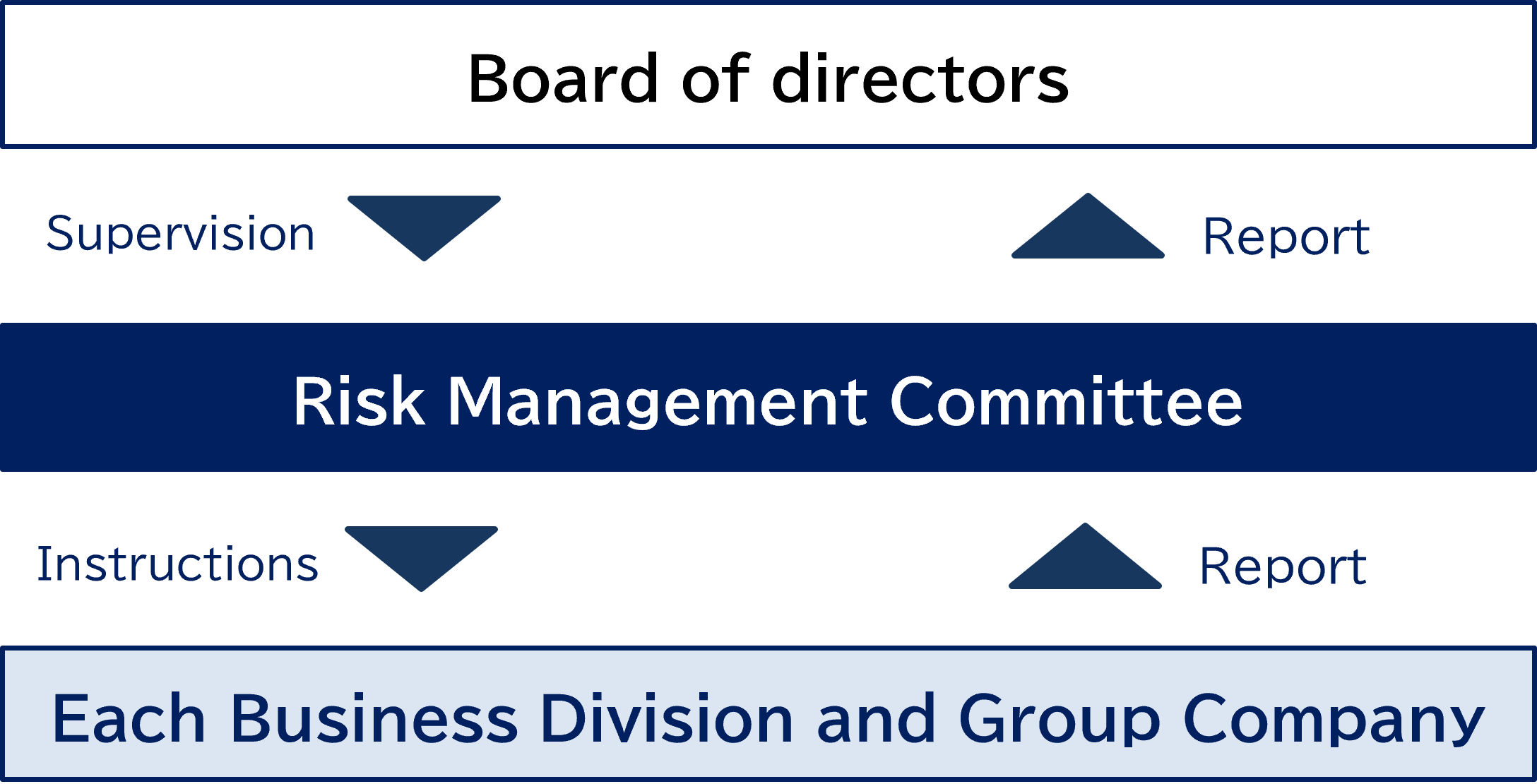
Our group has established a Risk Management Committee chaired by Representative Director and President. This committee develops implementation plans for significant risks that have been assessed and identified, and conducts risk management activities accordingly. We monitor the progress of these activities quarterly, confirming the progress of countermeasures and making revisions as necessary.
Furthermore, significant risks are reported to the Board of Directors, which oversees the risk situation, including risk management.
The following are the major risks that management recognizes as potentially having a significant impact on the consolidated company's financial condition, operating results, and cash flows, among the matters concerning the business and accounting conditions described in the securities report:
Please note that any forward-looking statements in this document are based on the judgments made by our group as of the end of the current consolidated fiscal year.
Furthermore, the timing of each risk's occurrence is indicated using the following timeframes as a guideline: short-term (generally within one year), medium-term (generally one to three years), and long-term (more than three years).
(Probability of occurrence: Low, Impact: High, Timing of occurrence: Short to medium term)
Our group is subject to various legal regulations and certifications in the course of our business operations, including the Construction Industry Act, the Product Liability Act, the JIS Act, various environmental laws, and various labor laws.
Failure to understand or comply with these laws and regulations, or failure to meet the standards when renewing licenses or permits, may result in administrative penalties, business suspension, or claims for damages.
The main licenses and permits held by our group are outlined below.
| Company name | Name of license etc. | Supervisory authorities, etc. | date of expiry |
|---|---|---|---|
| Vertex Co., Ltd. | General construction business license | Ministry of Land, Infrastructure, Transport and Tourism | January 24, 2031 |
| Vertex Construction Co., Ltd. | Special construction business license | Ministry of Land, Infrastructure, Transport and Tourism | January 15, 2030 |
| IKK Corporation | Special construction business license | Ministry of Land, Infrastructure, Transport and Tourism | December 3, 2026 |
| HOKUKON MATERIAL Co., Ltd. | General construction business license | Ministry of Land, Infrastructure, Transport and Tourism | December 19, 2026 |
Our group is working to strengthen its compliance system through continuous monitoring of legal revisions, implementation of compliance training for all employees, and thorough quality control activities.
However, it is difficult to completely eliminate the risk of compliance issues arising due to changes in legal interpretation or unforeseen events, and if such risks materialize, it could have a significant impact on the Group's performance and financial condition.
(Probability of occurrence: Low, Impact: High, Timing of occurrence: Short to medium term)
Our group operates sales offices and factories throughout Japan. In the event of large-scale natural disasters such as earthquakes and floods, or outbreaks of infectious diseases, if these business locations are affected, it may result in damage to employees, buildings, and equipment, and disruption or stagnation of raw material procurement and product supply, potentially impacting the continuation of our business activities.
Furthermore, there is a risk of serious accidents and workplace injuries occurring at our group's factories and product installation sites. In the event of a serious accident or workplace injury, the resulting human and property damage, compensation costs, production stoppages, etc., could affect our group's financial condition and performance.
To ensure the safety of our employees and minimize the impact on our business operations, our group has formulated Business Continuity Plans (BCPs) at our head office and key locations in each region. We have also established a disaster response headquarters to handle initial responses in the event of a disaster, and are working to create an environment that enables rapid recovery of operations by establishing a backup system for head office functions and decentralizing design and development functions. Furthermore, we are striving to prevent accidents and disasters through thorough maintenance and inspection of equipment, comprehensive safety and health education, and regular safety patrols.
However, in the event of a widespread disaster exceeding our expectations or long-term supply constraints, the prolonged recovery period could potentially impact our group's performance in the medium to long term.
(Probability: High, Impact: Medium, Timing: Short-term)
Our group's sales are influenced by a seasonal fluctuation, as a certain percentage of our revenue comes from transactions related to public works projects. This tends to cause a concentration of orders and construction work in the latter half of the fiscal year, resulting in a higher proportion of sales in the second half compared to the first half.
Furthermore, if there are delays in the progress of construction work or delays in acceptance testing that were scheduled for the end of the fiscal year, the recognition of sales may be carried over to the next fiscal year, which could affect the performance of the current fiscal year.
If these seasonal fluctuations become even more pronounced due to factors such as unfavorable weather or changes in the timing of public works orders, it could affect quarterly performance, particularly in the first half of the year.
Our group is working to diversify its business portfolio by expanding its products and services for the private sector, and to mitigate seasonal fluctuations in performance by leveling out its production and construction systems.
(Probability of occurrence: Low, Impact: High, Timing of occurrence: Medium to long term)
In our group's concrete business, Slope Disaster Prevention Business, and segment business, a significant portion of our sales depend on public works projects. Our group concentrates its management resources on supplying various products, materials, and construction methods essential for the development of social capital and living infrastructure, focusing on products necessary for strengthening national resilience and disaster prevention/mitigation, as well as maintenance of aging infrastructure. We develop our business by identifying public works areas where budgets are prioritized even in challenging financial circumstances, and we are also actively promoting the expansion of the supply of products for private demand in suburban areas of cities where construction investment is large.
However, depending on the scale of future public works projects and the allocation of their budgets, our group's performance could be significantly affected.
(Probability of occurrence: Medium, Impact: High, Timing of occurrence: Short to medium term)
In our group's concrete, Pile Business, and segment businesses, the competitive environment remains challenging due to structural changes in domestic construction demand and fluctuations in regional supply and demand. Under these circumstances, in our concrete and segment businesses, we are focusing on securing orders for high value-added products that are less susceptible to price competition, and are striving to maintain and expand our performance by increasing their proportion. Meanwhile, in Pile Business business, we are strengthening sales of the Hyper Straight method, one of the high-bearing-capacity pile construction methods for which demand is increasing, and are also focusing our sales area on regions where we have a strong presence, in order to maintain and improve profitability.
However, if product lines that are difficult to differentiate based on product functionality or construction quality are subjected to more intense price competition than anticipated, it could have a significant impact on our group's performance.
(Probability: High, Impact: Medium, Timing: Short-term)
The main raw materials for our group's concrete business, Pile Business, Slope Disaster Prevention Business, and segment business, namely cement and steel, as well as petroleum as fuel, are subject to market fluctuations, and their prices can change significantly depending on international affairs, exchange rate trends, supply and demand trends, etc.
Furthermore, due to chronic labor shortages in the logistics industry and the enforcement of the revised Work Style Reform Act in April 2024, our group's product transportation costs are on an upward trend year after year.
Our group is working to reduce costs through improved productivity, lower transportation costs by shifting production to factories closer to delivery locations, and revise selling prices. However, if the prices of raw materials and other materials continue to rise due to future market trends, and we are unable to pass on all of the increased costs to our customers, it may have a certain degree of impact on our group's performance.
(Probability: Medium, Impact: Medium, Timing: Medium-term)
Against the backdrop of a chronic labor shortage in the construction industry, there is growing momentum to expand the adoption of concrete products that are superior in quality and construction time compared to on-site poured concrete. However, this is also making it difficult for our group to secure personnel. Our group is striving to strengthen our ability to recruit personnel, shorten working hours and introduce flextime, enhance flexible leave systems including childcare and eldercare leave, and create a work environment in which diverse personnel can work flexibly according to their individual circumstances. In addition, in the production division, we have begun introducing robots into some processes as part of our efforts to reduce manpower in production and shipping preparation processes.
However, if we are unable to secure the necessary personnel as quickly as anticipated and are unable to meet customer needs, it could have an impact on our group's performance.
(Probability of occurrence: Low, Impact: Medium, Timing of occurrence: Medium-term)
Our group conducts research and development activities aimed at developing and bringing to market products that anticipate market needs and wants. In addition to our existing technology departments, we established a Technology Research Institute in April 2023, introducing a system for group-wide consideration, evaluation, and progress management of development themes, and we are working to achieve sufficient results. However, there is no guarantee that all of these activities will lead to future profits, and the results of our research and development activities could potentially impact our group's performance.
Furthermore, while our group is working to further grow its concrete, Pile Business, and Slope Disaster Prevention Business, we are also pursuing other business ventures and exploring new businesses while controlling risks. However, if these activities do not yield the expected results, it may affect our group's performance due to delays in investment recovery or the occurrence of additional costs.
(Probability of occurrence: Low, Impact: Medium, Timing of occurrence: Medium to long term)
For the Group, intellectual property rights such as patents are one of the factors that differentiate us from other companies and are important management resources. The Group takes appropriate procedures for acquiring and protecting intellectual property rights in accordance with laws and regulations, and takes great care not to infringe on the rights of third parties, including intellectual property rights.
However, if the Group's intellectual property rights are not adequately protected, or if the Group infringes the rights of a third party, this could adversely affect the Group's business performance, including the loss or reduction of revenue opportunities and the payment of damages.
(Probability: Medium, Impact: High, Timing: Short-term)
Our group holds confidential customer information as well as trade and technical confidential information.
This information is at risk of leakage or loss due to cyberattacks, unauthorized access, internal fraud, loss of information equipment, etc. In recent years, cyberattacks have become more sophisticated and diverse, and the level of information security risks surrounding our group has also changed.
Our group has established information management regulations, provided training, implemented access control measures, and taken other technical countermeasures.
However, even with these measures in place, it is difficult to completely eliminate the risks, and if such an event were to occur, it could affect our group's performance due to damages, loss of reputation, etc.
(Probability of occurrence: Low, Impact: Medium, Timing of occurrence: Medium-term)
Our group continuously invests in equipment to improve quality or productivity. We also conduct M&A as needed to grow our business. When making investment decisions, our group carefully considers the return on investment, and in the case of M&A investments, we strive to maintain and improve the value of the investment by providing appropriate management guidance and actively participating in and collaborating to create synergies even after the investment is made. However, if tangible fixed assets and intangible fixed assets, including goodwill, do not generate the expected cash flows, it may become necessary to recognize impairment losses, and if a significant impairment loss is recognized as a result, it may have an impact on our group's performance.