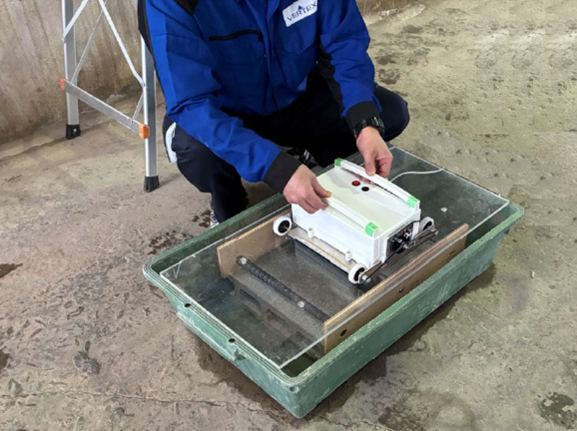
Vertex and the Institute of Scientific and Industrial Research at Osaka University have begun joint development of a rebar scanner for underwater exploration.
~ To improve infrastructure maintenance and management by diagnosing fire hydrants and other water sources without draining them ~
Vertex Co., Ltd. (Headquarters: Chiyoda-ku, Tokyo; Representative Director and President: Yuzuru Yamamoto) has begun development of a new device using the "permanent magnet method," a technology developed by Professor Daichi Chiba of the Institute of Scientific and Industrial Research, Osaka University, which enables non-destructive, high-speed, and high-precision visualization of the reinforcement arrangement inside concrete.
This device employs a "permanent magnet method," implementing a new technology that enables exploration in underwater and humid environments. This is expected to allow inspections and diagnoses to be performed while maintaining infrastructure functionality, without the need for temporary water draining procedures that were previously required.
This project aims to commercialize the product within the current fiscal year, and development will proceed with a view to expanding its application to a wide range of infrastructure fields, including fire-fighting water tanks, sewage systems, and tunnels.

Background: The challenges of aging infrastructure and inspections.
In Japan, concrete structures built during the period of rapid economic growth are aging, and infrastructure accidents, including road collapses, have become a social issue. To prevent such accidents, technology that can non-destructively, quickly, and accurately assess the internal condition of concrete is essential.
On the other hand, the vast majority of concrete infrastructure in Japan is located in "humid environments" that are constantly saturated with moisture, such as underground, in the ground, in rivers, and along the coast. However, conventional inspections often assume that the area under investigation is in a dry state, making accurate exploration difficult in flooded or humid environments, which has led to the following challenges.
- During inspections, it is necessary to shut down the system's original functions.
- Drainage work is time-consuming and costly.
Measurement accuracy decreases in aquatic environments.
Furthermore, conventional electromagnetic radar-based inspections, which are the mainstream technology, are susceptible to the effects of moisture and humid conditions, making underwater exploration difficult, and also have limitations such as requiring a long time for wide-area surveys.
Thus, conventional inspection methods, which are based on the assumption of dry conditions, have made it difficult to achieve efficiency, continuity, and practicality in maintenance management in the humid environments that constitute the majority of infrastructure.
Features of the developed technology
■ Measurement is possible even in underwater and humid environments.
This technology employs a "permanent magnet method" that is less susceptible to the effects of water.
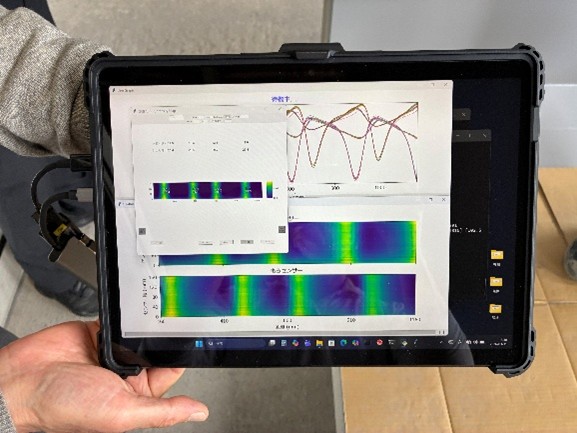
This makes it possible to estimate the location of reinforcing bars, concrete cover thickness, and diameter of reinforcing bars even when the reservoir is full of water or in a humid environment.
■ Non-destructive, high-speed, area-based exploration
By scanning the concrete surface, the internal reinforcement bar layout can be visualized non-destructively. This eliminates the need for extensive preparation work, as in conventional methods, and is expected to be used for efficient surveys and diagnoses.
■ High-precision detection using the "permanent magnet method"
By combining permanent magnets and magnetic sensors, we can detect changes in the magnetic field around the reinforcing bars to estimate information such as the position of the reinforcing bars, the concrete cover thickness, and the diameter of the reinforcing bars.
Unlike methods that use electromagnetic waves, its greatest advantage is that it is less susceptible to the effects of moisture.
Application to fire hydrant inspection
This technology is expected to be of great value in the maintenance and management of fire-fighting water tanks, an area in which Vertex excels.
Fire-fighting water tanks are an important source of water for initial firefighting and when fire hydrants are unusable, and they are also a vital social infrastructure that can be used as a source of water for daily life during disasters. Their importance has been reaffirmed in events such as the Great Hanshin-Awaji Earthquake and the Noto Peninsula Earthquake.
On the other hand, there are many cast-in-place fire cisterns in Japan that have been in place for over 50 years, and many of them are still in use. If proper inspection and maintenance are not carried out, there is a risk that they will not be able to function adequately in the event of a fire or disaster.
Traditionally, internal inspections of fire-fighting water tanks required draining the water, but the use of this technology is expected to yield the following benefits:
- Allows you to check the internal condition without draining the water.
- Can maintain its function as a fire-fighting water tank even during inspections.
- Reduces the time and cost associated with drainage work.
- Leads to increased efficiency and improved safety in inspection work.
This makes it possible to maintain aging fire-fighting water tanks in a condition that allows them to be reliably used when needed.
Technical concept
This technology is based on the concept of "making the interior of structures visible while maintaining social functions."
Our aim is to significantly advance infrastructure maintenance by unraveling the inner workings of concrete structures without damaging them, thereby simultaneously achieving increased efficiency and sophistication in maintenance and management.
Vertex's initiatives
Vertex leverages its strength in maintenance technology, which involves taking on infrastructure maintenance and management from the upstream stages, providing one-stop services from surveys and diagnoses to maintenance and management, and is working to maintain the functionality of fire-fighting water tanks.
By utilizing this technology, we aim to achieve more efficient and reliable maintenance and management while effectively making use of existing facilities.
Future developments
Vertex and the Institute of Scientific and Industrial Research at Osaka University will further promote joint development with the aim of commercializing the product within the fiscal year. They are also considering expanding the application beyond fire-fighting water tanks to a wide range of infrastructure fields, including sewage systems and tunnels.
Furthermore, through this technology, we aim to contribute to improving the efficiency of infrastructure inspections, reducing maintenance costs, and maintaining social functions during disasters.
Inquiries regarding this matter
ベルテクス株式会社
TEL:03-3556-0464
E-mail:sales-support@vertex-grp.co.jp
大阪大学 産業科学研究所 広報室
TEL:06-6879-8524
E-mail: press@sanken.osaka-u.ac.jp